The Short Answer
Yes — engineered hardwood floors can be sanded and refinished, but only if the wear layer is thick enough. The critical measurement is 3mm or more of real hardwood on the top layer. Below that threshold, sanding risks cutting through into the core material underneath, which cannot be finished. The good news: a significant proportion of engineered hardwood floors installed in Toronto condos and homes over the past 15 years have a wear layer of 3mm or more — which means they are refinishable. The bad news: many homeowners, and even some contractors, assume they're not — and recommend replacement unnecessarily.How Engineered Hardwood Is Constructed
To understand why the wear layer matters, it helps to understand how engineered hardwood is made. Unlike solid hardwood — which is a single piece of wood throughout — engineered hardwood is a layered product:- Top layer (wear layer) — real hardwood veneer, anywhere from 0.5mm to 6mm thick depending on the product quality
- Core layers — multiple cross-grain layers of plywood or HDF (high-density fibreboard), providing stability
- Bottom layer — a backing layer for moisture balance
The Wear Layer — The Key Measurement
The standard threshold for engineered hardwood refinishing is a minimum 3mm wear layer. Here's why:- Sanding removes approximately 0.5–1mm of material per refinishing
- A 3mm wear layer allows for 2–3 refinishings over the floor's lifetime
- Leaving a safe buffer above the core prevents accidental breakthrough
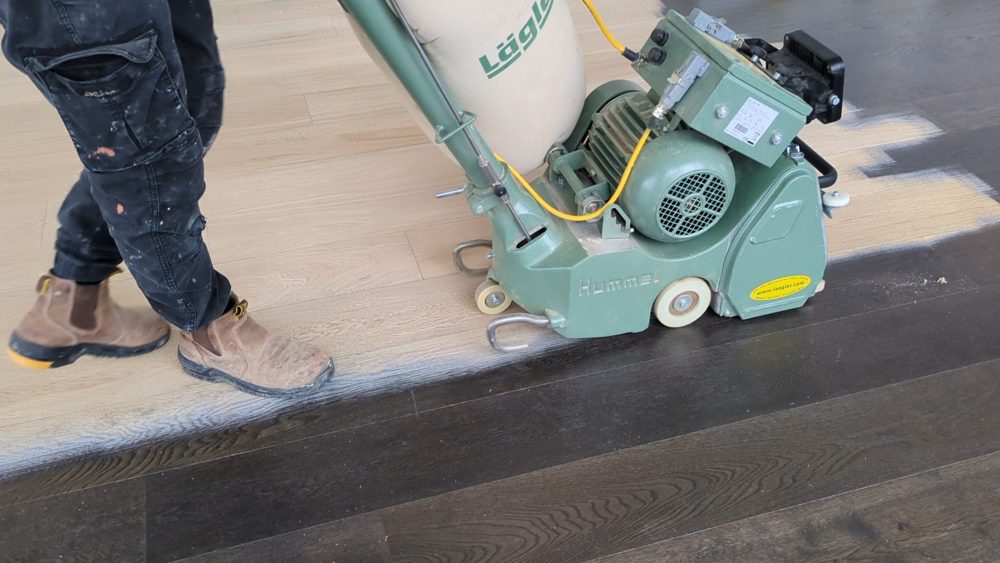
- An experienced technician using the right equipment (Lägler Hummel) can sand very precisely — but there must be enough material to work with
How MKZ Approaches Engineered Floor Refinishing We use the Lägler Hummel drum sander — the industry's most precise sanding machine — for all engineered floor work. Its orbital action is gentler than traditional drum sanders, reducing the risk of wear-through and producing a more uniform result on thin veneers. We measure the wear layer before committing to any engineered floor refinishing job.
How to Check If Your Engineered Floor Can Be Refinished
There are a few ways to check the wear layer thickness on your engineered hardwood:Check the Original Product Documentation
If you have the original flooring documentation, installation receipt, or the product is still available, the wear layer thickness is almost always listed in the product specifications. Look for terms like "veneer thickness," "wear layer," or "top layer thickness."Look at a Cross-Section
If there's an accessible edge — at a doorway, vent, or where the floor meets another material — you can often see the layered construction of the floor. The top light-coloured wood layer is the wear layer. A rough estimate from visual inspection can tell you if it's clearly thick (3mm+) or thin (under 2mm).Get a Professional Assessment
The most reliable method is a professional in-home assessment. At MKZ, we inspect the wear layer as part of our free consultation and give you a clear answer before any work is proposed.The Refinishing Process for Engineered Floors
Refinishing engineered hardwood is similar to refinishing solid hardwood, with some key differences in approach:- Equipment — we use the Lägler Hummel orbital sander rather than an aggressive drum sander, to minimize material removal while achieving a consistent scratch pattern
- Grit progression — we start with a finer grit than solid hardwood refinishing, removing less material per pass
- Staining — colour changes are possible on engineered floors with adequate wear layer thickness
- Finishing — same 3-coat water-based finish process as solid hardwood
Condo-Specific Considerations
Engineered hardwood refinishing is particularly common in Toronto condos — and comes with some building-specific considerations:- Building approval — many condo buildings require prior approval for any work involving sanding equipment. We can provide a letter outlining our process and proof of $5M liability insurance for building management
- Noise restrictions — most buildings have restricted hours for noisy work. We schedule all sanding within permitted hours
- Dust control — our professional dust containment system is essential in condos, where dust can travel to shared hallways and neighbouring units
- Access — elevator access and parking for our van are typically arranged in advance with building management
When Engineered Floors Cannot Be Refinished
There are situations where engineered floor refinishing is not possible:- Wear layer under 2mm — not enough material for safe sanding
- Previous refinishing that consumed most of the wear layer — if the floor has already been sanded once on a thin veneer, there may be nothing left
- Structural delamination — if the layers are separating, sanding will worsen the problem
- Moisture damage to the core — water that has penetrated to the plywood core causes delamination that cannot be fixed with sanding
Not Sure Which Service You Need?
We assess your floor for free and give you an honest recommendation — buff & recoat or full sand. No upselling, no pressure.