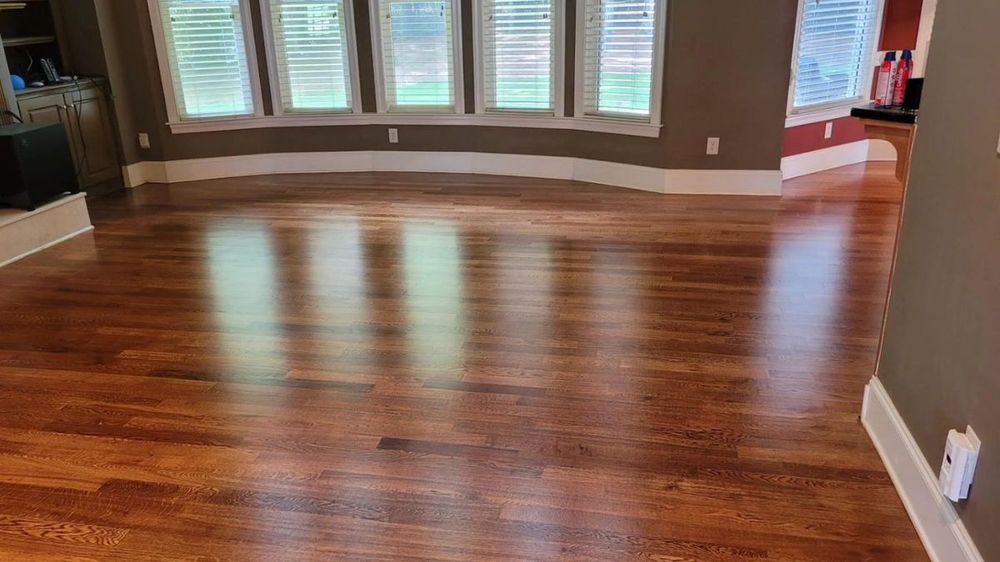
What Is Buff & Recoat?
A buff & recoat (also called a screen & recoat or light sand) is a maintenance service that refreshes the protective finish on your hardwood floors without sanding down to bare wood. Here's what the process involves:- Light abrasion — a buffing machine with a fine abrasive screen scuffs the surface of the existing finish, creating a mechanical bond for the new coats
- Cleaning — the abraded surface is thoroughly cleaned and vacuumed
- New finish — 2 fresh coats of water-based finish are applied over the existing floor
What Is Full Sand & Refinish?
A full sand & refinish is a complete floor restoration. It involves:- Heavy sanding — a drum sander removes the existing finish and a layer of wood, taking the floor back to bare wood
- Edge sanding — an edge sander addresses the perimeter that the drum sander can't reach
- Staining (optional) — stain is applied to the bare wood if a colour change is desired
- Sealing and finishing — 3 coats of water-based finish are applied with light sanding between coats
When Buff & Recoat Is the Right Choice
Choose a buff & recoat when all of the following are true:- Your floor has surface dullness but no deep scratches through the finish
- You're happy with the current colour
- There's no wax, oil, or polish buildup on the floor
- The floor hasn't had more than 1–2 previous buff & recoat services without a full sand in between
- The floor was last refinished within the past 8–12 years
The Preventive Maintenance Principle The ideal maintenance schedule is a buff & recoat every 4–5 years, with a full sand & refinish every 10–15 years. Staying on this schedule means your floor never gets to the point where it looks terrible — and the total cost over the floor's lifetime is significantly lower.
When Full Sand & Refinish Is Necessary
A full sand & refinish is necessary when:- Deep scratches have penetrated through the finish into the wood
- You want to change the colour of your floor
- There is wax, oil, or polish contamination that chemical stripping alone can't address
- The floor has been buff & recoated multiple times and the finish is no longer adhering properly
- There is significant staining or discolouration in the wood itself
- The floor has structural surface issues (minor cupping, grain raise) that need to be levelled
The Wax Problem — Why It Changes Everything
This is the single most common reason a buff & recoat fails — and it's something many refinishing companies don't explain clearly enough upfront. If your floor has been treated with any wax-depositing product — Rejuvenate, Mop & Glo, Murphy's Oil Soap, Quick Shine, or similar — a buff & recoat will almost certainly fail. The new finish will not bond to the wax contamination and will begin to peel within days or weeks of application. Before a buff & recoat can be performed on a contaminated floor, the wax must be chemically stripped. This is an additional step and cost. In some severe contamination cases, the only real solution is a full sand — which physically removes the contamination by removing the top layer of wood along with the finish. At MKZ, we test every floor for wax contamination before recommending a service. If your floor has been treated with polish products, we'll tell you — and tell you exactly what needs to happen before the floor can be properly refinished.Timeline Comparison
- Buff & recoat — typically 1–2 days. Light foot traffic in 4 hours of final coat. Furniture back in 48 hours
- Full sand & refinish — typically 4–5 days for a 1,000 sq ft floor. Light foot traffic in 4 hours of final coat. Furniture back in 48–72 hours. Rugs after 7 days
Not Sure Which Service You Need?
We assess your floor for free and give you an honest recommendation — buff & recoat or full sand. No upselling, no pressure.